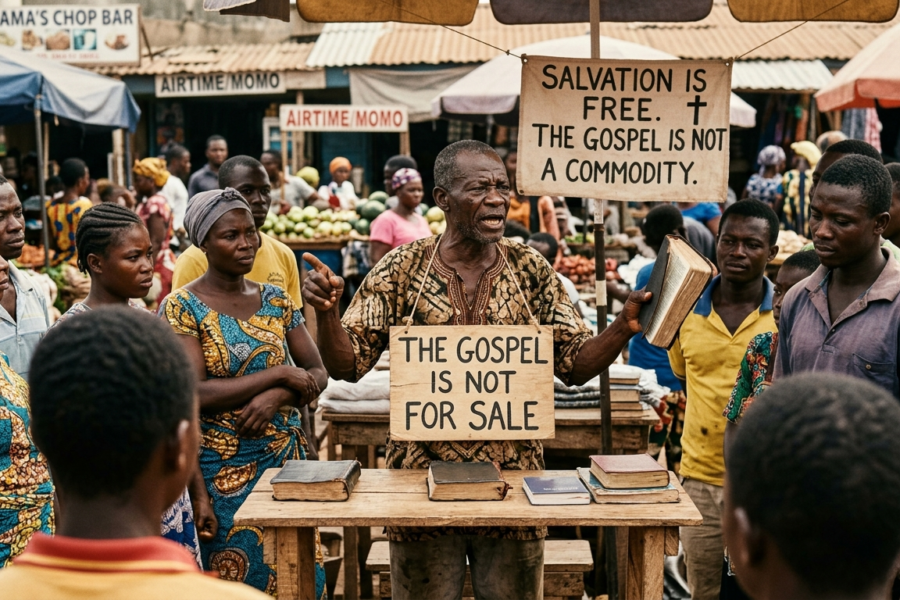

One of the tools I have found useful in talking to people about their beliefs in the prosperity gospel is exegesis. By that, I mean the practice of rightly extracting meaning from particular texts. That exercise usually clears up many of the errors of this belief system.
However, I have learned that good exegesis will only go so far in dealing with the prosperity gospel. There are passages that prosperity preachers use on which I agree with their exegesis. For example, a prosperity preacher may quote Psalm 112.1-3:
‘Praise the LORD! Blessed is the man who fears the LORD, who greatly delights in his commandments! His offspring will be mighty in the land; the generation of the upright will be blessed. Wealth and riches are in his house, and his righteousness endures forever.’
On such a passage, I would agree with them on the straightforward meaning of the passage- The righteous man will be blessed with mighty offspring and wealth in his house. Whilst the prosperity preacher would be right in noting that this is what the text teaches, he would still be wrong in applying it directly to Christians today. But how do I come to that conclusion? I am using a different tool called Biblical Theology. More on this passage later.
First, a detour.
A brief detour
Biblical theology is a way of looking at the message of the Bible by considering how it all fits together into one. It follows how the story unfolds from one stage of redemptive history to another and seeks to understand the different parts in their proper place within that unified whole. It assumes that because the Bible has one author, namely God, all its 66 books have themes that cohere and together tell one great story. Michael Lawrence helpfully summarizes Biblical theology as ‘the attempt to tell the whole story of the Bible as Christian Scripture’ (Biblical Theology in the life of the Church, crossway 2010)
It might be useful at this point to distinguish Biblical Theology from Systematic Theology. Biblical Theology is concerned with how Biblical themes develop, relate and cohere across the history of redemption. Systematic Theology is concerned with summarizing and organizing everything the Bible has to say about any given topic. According to Lawrence, the former employs ‘storyline’ thinking whilst the latter employs ‘bottomline’ thinking. Both are needed.
The prosperity gospel demonstrates a lack of sound Biblical theology, hence some of its most notorious errors.
Direct links
The prosperity gospel holds that the blessings of health and wealth are guaranteed to Christians in this life on account of their faith. For this claim, prosperity preachers rely heavily on the Old testament. The reason for this is fairly obvious. In the Old testament you meet a God who enters into covenantal relationships with people and makes promises to them of material blessings. Without skipping a beat, prosperity preachers directly link those promises and blessings with Christians today. Let’s take two common narratives as an example: God’s dealings with Abraham and with the nation of Israel. According to them, God’s promises to Abraham and those of blessing listed in passages like Deuteronomy 28 are directly meant for Christians today.
Is this how we are to understand these narratives? It is at this point that good Biblical Theology comes in handy.
The blessing of Abraham
Let us consider God’s covenant with Abraham. (Gen 12.1-3, 15, 17, 22.15-18). In it, God made Abraham promises that had personal, national and multinational implications. The personal promises included a son from his own body through Sarah, a great name, a long and full life, protection and material reward. The National promises pointed to a great offspring that would be constituted into a nation to whom the land of Canaan would be given. The multinational promises pointed to blessing on all the families of the earth through Abraham and his offspring.
Biblical theology allows us to see how these ‘blessing’ promises unfold and are fulfilled over the course of redemptive history. Note how the personal promises were all fulfilled: Isaac is born to Abraham and Sarah, God continually protects and blesses them wherever they go, Abraham lives a full life and dies old and grey as God had promised.
The national promises are fulfilled too. As the story unfolds, Abraham’s descendants continue to grow and eventually end up in Egypt. Everytime we read how they ‘grew and multiplied’ (e.g. in Ex 1.7) we are hearing an echo back to God’s promise to give Abraham an innumerable number of descendants. The books of Exodus, Numbers and Deuteronomy record how God delivers them out of bondage in Egypt and leads them through the wilderness. By the time we get to the end of the book of Joshua, Abraham’s descendants are all settled in the land that God promised them. (Joshua 21.43-45)
As the story unfolds, the multinational promise begins to find fulfillment. Under Solomon’s peaceful and prosperous reign, world leaders come to see and gain from him. (e.g 1 Kings 10) And yet, that didn’t fully spread God’s blessing to all the nations of the world. That became a reality with the coming of Abraham’s greater offspring, Jesus Christ. Through His life and death, Jesus purchased the blessing of salvation for people from every language, tribe and nation. Jesus is the offspring of Abraham who unleashes blessing to the nations. Galatians 3.13-16 tells us that this blessing is salvation and the coming of God’s spirit upon all who believe. These, whether Jew or Gentile, are Abraham’s true offspring (e.g Rom 9.6-8).
Interestingly, there is yet another stage in the fulfillment of God’s multinational promise to Abraham. The book of revelation shows us how it all culminates in Abraham’s true offspring, the multitude of believers from every language, tribe and people all settled in the true Canaan, the new heavens and new earth with God Himself dwelling in their midst. (Rev 21-22)
When we use our Biblical Theology lenses to zoom out a little more, we learn that the promised seed of Genesis 3.15 who would vanquish the serpent is one and the same as Abraham’s seed who would bring blessing to the nations. It turns out that in vanquishing the serpent, he would also be obtaining salvation for all who would trust in Him. The calling of Abraham is not a detour but a crucial stage in the development of the story of redemption that had been unfolding since the fall of man.
This is to a large part what the personal promises to keep Abraham and his family safe really have to do. God was protecting His chosen channel to bring this promised seed onto the stage of history to fulfill the plan of redemption.
What Biblical Theology allows is for us to see how exactly Christians today are beneficiaries of God’s promise to Abraham. We are the beneficiaries of the multinational promise to bless the nations through Abraham and his seed, Jesus Christ. That blessing is not financial. It is salvation and all it entails for this life and for eternity.
It also shows us God’s character. He is faithful in keeping His promises to Abraham. We can trust Him to keep His promises to us. The promises may differ, but the God who made them is the same.
Prosperity preachers, defacto, assume that God’s personal promises to Abraham are universal to all Christians. This is plainly wrong when one considers all we have looked at above. God has not promised Christians today what He promised to Abraham all those years ago. We should not directly seek to claim the Abrahamic promises of fame, fortune, family, a long life and a peaceful death anymore than we should seek to claim the Abrahamic promises of an innumerable number of descendants being constituted as a special nation and given a physical land. We see how Biblical theology keeps us from this error by showing us the proper path we must follow to understand the Abahamic story.
From Old to New
Another stage in the development of the story of redemption which prosperity preachers misunderstand is God’s covenant with Israel. We have seen how the outworking of God’s promises to Abraham leads us down through time to the Exodus. After 400 years in Egypt, God remembers his covenant with Abraham and raises up Moses to go and deliver them from their bondage in Egypt.(Exodus 3.8) After delivering them, God brings them to the foot of Mt Sinai and proceeds to enter into a covenant with them (Exodus 19-24.) This covenant, (known as the Mosaic covenant or more Biblically, the Old Covenant) formally constitutes Abraham’s physical descendants into a nation under God.
The covenant spells out God’s elaborate law that is to govern how they will live. This law is meant to turn them into a peculiar nation among all the nations of the world. God promises to bring them into the land of Canaan and to keep them in it provided they faithfully keep the covenant. Deuteronomy 28 (compare with Leviticus 26) stands as a central passage for this idea.
The blessings of this covenant had a pronounced material element, not the least of which was the provision of the entire land of canaan as a possession for them. Prosperity preachers gravitate to the material blessings of this covenant and seek to appropriate them to Christians today.
Once again, Biblical theology helps us to avoid this error.
We begin by noting that the Jews lived all of their lives with reference to this covenant. Everything they did was hinged upon its stipulations. Their sacrificial system was an outworking of this covenant. Their various offerings, festivals and feasts were all part and parcel of this covenant. Their clean and unclean laws were stipulations under this covenant. Their judicial processes were all encoded in the covenant. When a person was described as righteous it meant that they were faithful to keep this covenant. When a person is described as wicked, it meant that their lives were out of accord with the stipulations of this covenant.
We also note that this covenant explains everything else we find in the succeeding history of Israel. Their prophets were really mouthpieces of the Covenant. All they did was call Israel to covenant faithfulness or issue strong warnings of judgement for breaking the covenant. (They also spoke of a future hope which we shall come to shortly) Their kings were evaluated on the basis of the covenant. Their destruction and bitter exile in Babylon was a result of breaking this covenant as warned in Deuteronomy 28.64-68.
When one reads the succeeding parts of the Old testament, they are reading about Israel under this Old Covenant.
At some point in the unfolding history of Israel, the prophets began to speak of a coming future hope to be realised under a new covenant. The most explicit of this is Jeremiah 31.33-34 where the prophet speaks of a future time when God would establish a new covenant with His people. This new covenant would be different from the old one in that God’s law would be written in the hearts of the people. In this new covenant, God would cleanse his people from their sins, pour His spirit upon them and establish an everlasting peace with them. Everything that could not be achieved by the old covenant in terms of reforming the people and securing their heart loyalty to God would be achieved under this coming new one.
Later on, the Lord Jesus Christ would explicitly relate His death and His blood with this New Covenant. Just as Moses called the blood of a bull which ratified the Old covenant ‘the blood of the covenant’ (Exodus 24.6-8), so Jesus would refer to his own blood as the blood of the New covenant. (Luke 22.20, Mark 14.24, Matthew 26.28). Jesus was saying that by His death, he would inaugurate the promised new covenant. Hebrews 8.7-13 would then teach that Christ’s death also brought an end to the Old covenant. Christ himself lived faithfully under the Old Covenant, fulfilled it and abrogated it by His death.
All the promises and stipulations of the Old Covenant were thus brought to an end in Christ and the Christian today belongs, not to the Old, but to the New Covenant. This new covenant has its own promises and blessings. It doesn’t have any promises of material prosperity, land etc in this life since the Church is not a Theocracy as Israel was. Its blessings are called ‘spiritual blessings in the heavenly realms’ (Ephesians 1.3.) These blessings, which are better than and superior to the physical blessings under the Old covenant (Hebrews 8.6), have been won for us by Christ’s perfect obedience and are thus irrevocably ours in Him. The new Covenant does promise perfect health, wealth and glory. However, that will come at the end of the age after Christ returns as a consummation of our salvation. Our inheritance is laid up for us in heaven and we have a downpayment of it in the Holy Spirit who dwells within us.(Eph 1.13-14)
Back to Psalm 112
This Biblical theological reading of the development of the Old Covenant, its fulfillment in Christ and the transition to a new one has obvious implications on how we read and apply the old testament. This brings us back to Psalm 112.1-3. That passage is embedded within the structure of life under the Old Covenant. The righteous man is the man who is faithful to keep the old covenant. The blessings of mighty offspring and riches in his tent are all promised to him for his faithfulness. Psalm 112 is really applying Deuteronomy 28.1-14 which promises blessing on offspring (v.4,11) and wealth (v.8,12) for the Jews if they kept God’s covenant.
However, we have seen that Christians today are not under this covenant but under the new. Therefore, one cannot directly apply psalm 112.1-3 (or all other texts like it in the Old T) to a Christian today and tell them that if they are righteous, they can expect wealth and a mighty offspring to be theirs. God has not promised that as a benefit of participation in the new covenant. Whilst that is not to say that God cannot bless a Christian in those ways, it is to say that a Christian is not promised those specific blessings by God as a Jew under the old Covenant was.
Conclusion
In summary, good exegesis helps with those texts which are misunderstood because of a failure to heed to their immediate context or the meaning of specific words. Biblical theology helps with those texts which are misunderstood because of a failure to incorporate the developments in redemptive history and to heed to the context of the Bible as a whole. If you happened upon a letter from your dad addressing one of your siblings, you would not automatically assume that everything he says to your sibling also directly belongs to you. In reading old testament passages, we are looking at our heavenly Father’s dealings and promises to others who went before us under different covenantal arrangements. We have much to gain from those stories, however we must be careful to make sure that we are gleaning implications and applications from them correctly. Good exegesis married with a sound biblical theology will help us in that gleaning process. May we thus be found faithful in wielding both tools to safeguard ourselves from errors, especially those of the prosperity gospel.