
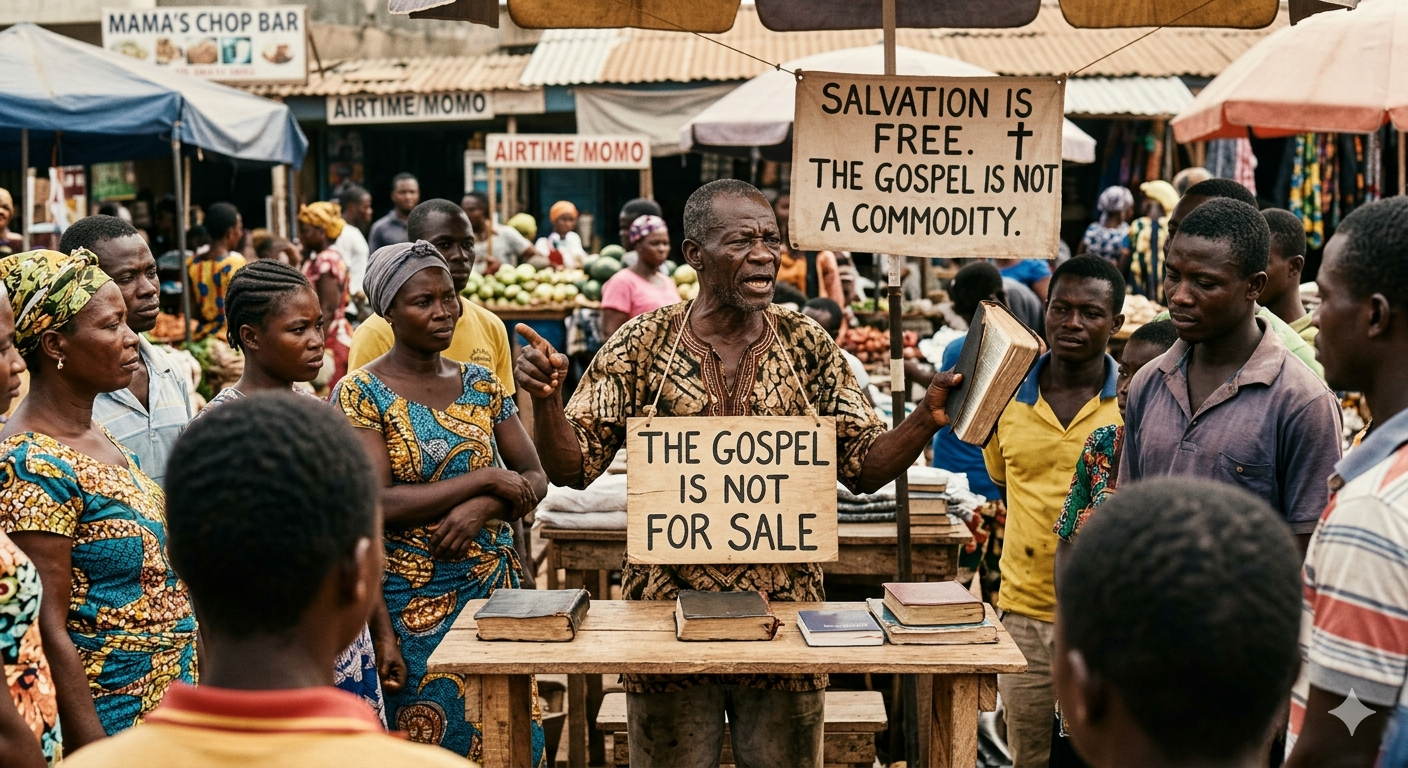
When I first read and signed the Africa Statement on the Prosperity Gospel and the Word of Faith, my heart was filled with joy because God in His mercy had raised up faithful witnesses to declare the truth of His word with clarity and conviction. However, I must say that I still have grief, especially as an African (a Kenyan) because of how deeply these false teachings have wounded people, in churches and society, in Africa. As a pastor, as a Christian, and as one who longs to see Christ magnified in His church, I cannot remain silent to this theological cancer. I must affirm with all my heart, and I urge you to affirm with me the truths set forth in that Statement. This is not merely about theological nitpicking. This is about life and death, truth and error, heaven and hell. The prosperity gospel and the word of faith movement do not merely add a small distortion; they corrupt the very heart of the gospel. They replace the rugged cross of Christ with a golden crown of worldly comfort. They shift our eyes from the eternal inheritance promised in Christ to the fleeting treasures of this present evil age. They twist the Scriptures, divorcing them from their covenantal and Christ-centered context, and they build entire ministries on what the apostle Paul called “another gospel, which is no gospel at all” (Galatians 1:6–7).
Today, I want to walk through the heartbeat of the Africa Statement with you. I want to affirm it. I want to show why it is Biblical, why it is necessary, and why it is ultimately good news. And I want to address objections head-on. I do so because those who love the prosperity gospel will push back. They will say we are negative, we are against blessing, we are resisting the Spirit. But the truth is the opposite: we are for the blessing of God, we are for the true work of the Spirit, we are for the true riches that cannot perish, spoil, or fade.
When you step back and look at all fourteen articles together, you see how beautifully they fit like pieces of a puzzle. The Statement doesn’t just throw random corrections at the prosperity gospel. It builds carefully, step by step, to show us the true shape of the gospel. It begins in the right place: with God Himself and His word (Articles 1–3). Before we can talk about money, health, or blessing, we must be clear on who God is. He is sovereign, holy, and not a servant to our whims. This helps us clarify what Scripture really teaches, rightly understood in Christ. Then the Statement sets Old Testament Israel and the old covenant in their proper place (Articles 4–6). This is crucial, because so much of prosperity teaching comes from grabbing Old Testament promises out of context and pasting them onto the church today. But those promises were shadows pointing to Christ and His eternal kingdom. The Statement reminds us that we live under the new covenant, where our inheritance is spiritual and everlasting, not simply material and temporary. After that, it gets very practical and pastoral (Articles 7–12). It addresses the everyday things people wrestle with: Christian suffering, giving, the power of words, the place of work, what faith is, and the renewal of the mind. Here the Statement shows the difference between God’s true ways of shaping us and the shortcuts the prosperity gospel tries to sell us. It also warns about the dangers of distorted leadership (Article 13), because false shepherds often use these teachings to build cult-like followings. The Statement insists that pastors are servants, not kings, and that Christ alone is Head of the church. Finally, it ends where all truth should end i.e., with worship and delight in God Himself (Article 14). Our greatest treasure is not health or wealth but God’s glory in the face of Jesus Christ. In short, the Africa Statement defends a gospel that is centered on Christ, rooted in covenant truth, deeply pastoral, and thoroughly faithful to Scripture. It doesn’t rob us of joy. It frees us to find joy where it truly belongs: in God Himself. This captures, in summary, the content of the 14 articles contained in the Statement. I want now to address some pertinent issues starting from the beginning. I will not deal with all issues in this post.
All true reform begins with Scripture. Thus, this Statement affirms the absolute sufficiency, authority, and clarity of the Bible. This is where the prosperity gospel already begins to stumble. It does not handle the word of God rightly. It reads the Scriptures as a collection of motivational slogans, detached from covenantal context, from redemptive history, and from Christ. How often have we heard Jeremiah 29:11 torn from its setting, “For I know the plans I have for you, declares the Lord, plans for welfare and not for evil, to give you a future and a hope”? This Scripture text is too often applied directly to a modern believer as a promise of a personal breakthrough, a job promotion, a healed body. Yet the Lord was speaking to exiled Israel, promising eventual return after seventy years of discipline. The prosperity hermeneutic takes what was covenantal to Israel and imports it into the church, without Christ, without cross, without covenant, that is, without proper Scripture interpretation which must employ all these. The early church fathers warned against this kind of misreading. Augustine wrote that “whoever takes another meaning out of Scripture than the writer intended, goes astray.” This is especially so when Christ is not found in our interpretation. The Reformers hammered this home: Scripture interprets Scripture, and all Scripture must be read in light of Christ. Calvin reminded us that the Old Testament promises of land, prosperity, and rest were “earthly shadows” pointing forward to the heavenly reality in Christ.
Do you see how the prosperity gospel severs shadow from substance? It wants the shadow without Christ. When I say that the prosperity gospel severs shadow from substance, I mean that it takes things God gave as pictures pointing forward to Christ, and treats them as if they were the final thing themselves. In the Old Testament, God gave Israel promises of land, prosperity, health, and victory over enemies. These were real blessings, but they were not the ultimate goal. They were shadows, previews, road signs. They pointed to something far greater, to Christ who brings eternal life, resurrection, and an inheritance that can never perish or fade. The prosperity gospel thus makes the mistake of clinging to the shadows as though Christ had not come. It says, “Look at Israel’s wealth, health, and land! That must be mine now.” But that is like a man hugging a wedding photograph while ignoring his wife who is standing in the room. The photograph was precious when he had travelled far away from her, because it pointed to the day when they would reunite. But once he is back home to her, why would such a man still prefer the photograph over the living spouse? In the same way, to cling to the Old Testament shadows of wealth and land while ignoring Christ is to prefer the picture instead of the Person. It takes what belonged to the covenant with Israel, and applies it to the church in this age as if Christ has not come. It is, in short, an abuse of the word.
The Statement goes on to affirm the true character of God. God is holy, sovereign, wise, loving. Here again the prosperity gospel falters. Its god is not the God of the Bible, but a genie, a cosmic butler, a power to be manipulated by positive confession. Think of the word of faith doctrine, “Speak it, declare it, claim it, and it will be.” This is not faith; it is magic (fictional abracadabra). It is an attempt to control God with words, as though He were bound by our declarations rather than by His own eternal decree. The Reformers called this blasphemy. Luther warned that when man seeks to control God, he is no longer worshiping God, but an idol of his imagination. One of the deepest errors of the prosperity gospel is to treat God as if He exists to fulfill our desires, like a heavenly ATM that dispenses blessings whenever we insert faith or seed offerings. But the true God of Scripture is not like that. He is sovereign, eternal, and unchangeable. He is not moved by human manipulation, but acts according to His wise and perfect will. Think of a child who insists that his father give him sweets for dinner every night. A loving father knows that endless sweets will rot his teeth and harm his health. So he says no, not because he doesn’t love his child, but precisely because he does. Now imagine that child throwing a tantrum, declaring that his words must force the father to comply. That is what prosperity teaching does with God. It presumes that if we just declare or “confess” the right words, God is bound to give us what we ask. But Scripture says otherwise: “Our God is in the heavens; He does all that He pleases” (Psalm 115:3). His sovereignty is not to harm us but to comfort us. We do not need a God who bows to our will. We need a God who rules all things wisely for His glory and our good. The comfort of the gospel is not that we can control God, but that we can trust Him. He is the One who knows the end from the beginning, and in Christ He is working all things together for our good. That is far better than having a God who simply gives us what we demand. Do you see the danger? When we distort God into a dispenser of material blessings, we are not merely tweaking theology, we are committing idolatry. The prosperity gospel replaces the true God with a false god who exists to serve our passions.
One of the most dangerous distortions of the Word of Faith movement handled by this Africa Statement is its teaching about the power of words. Prosperity preachers often claim that your tongue can “create reality,” that you can “speak things into existence,” that “positive confession” will manifest health, wealth, and success, while “negative confession” will bring sickness and failure. They misquote verses like Proverbs 18:21, “Death and life are in the power of the tongue.” Using this, they teach that your spoken words have Divine creative force. They will even point to God’s act of creation, “And God said…” and conclude that since we are made in His image, our words carry the same creative power. The Africa Statement directly rejects this teaching. It reminds us that God alone speaks things into existence. Creation ex nihilo (out of nothing) belongs to Him alone. Our words are not God’s words. They can bless or curse in the human sense, they can edify or destroy reputations, they can encourage or wound hearts, but they cannot call forth universes. To equate our words with God’s sovereign speech is blasphemous and dangerously misleading. The Word of Faith teaching rests on a very dangerous interpretation. It lifts isolated verses without context, ignores the covenantal structure of Scripture, and attributes to man what belongs to God alone. When Proverbs 18:21 speaks of life and death being in the tongue, it is not teaching metaphysical creation. It is a wisdom proverb, describing the real consequences of our speech in community, with those around us. Words can kill reputations, divide churches, destroy marriages. Words can also bring healing, reconciliation, comfort, and hope. But this is a far cry from declaring, “I will never be sick,” and expecting your body to obey. James gives us the right interpretation. He calls the tongue a “fire, a world of unrighteousness” (James 3:6). It is powerful, yes, but its power is to corrupt, to boast, to defile. Who of us has not stumbled in word? “If anyone does not stumble in what he says, he is a perfect man” (James 3:2). This is not a license to create reality with words, but a warning to bridle the tongue, to use speech in holiness. Think of how this doctrine harms believers. A sick Christian is told, “Do not confess your sickness, or you will make it real.” A poor believer is told, “Do not admit poverty, or you will stay poor.” The result is guilt, bondage, and despair. Instead of being free to cry out like the psalmists, “I am afflicted and in pain” (Psalm 69:29), or like Paul, who admitted his “thorn in the flesh” (2 Corinthians 12:7), believers are forced into a false positivity that denies reality. This is not faith; it is deception. The true Biblical use of words is not to create but to confess. We confess Christ. We confess our sins. We confess our hope. The tongue’s greatest power is not creative magic but covenantal witness. “If you confess with your mouth that Jesus is Lord and believe in your heart that God raised Him from the dead, you will be saved” (Romans 10:9). That is the proper power of the tongue and we need to use them to align with God’s word in faith and obedience, not to invent realities out of thin air. The Africa Statement calls us back to this. It points us to the gospel of Christ, the true Word made flesh. It urges us to reject superstitious word games and cling to the speech of Scripture. Let us then use our tongues not for vain decrees, but for prayer, praise, confession, blessing, and proclamation of the gospel. That is the true, God-honouring power of words.
The Statement deals clearly with Christ Himself, His person and work, His death and resurrection, His present reign and future return. And here the prosperity gospel is most deadly, because it shifts Christ from centre to side. O, do not misunderstand me. Prosperity preachers will talk of Jesus, yes, but not as the crucified Lord who bore the wrath of God for sinners. They speak of Him as a model of success, a wealthy man who wore designer clothes and entered Jerusalem triumphantly in the most rare of animals to show His opulence, a victor who guarantees our earthly victory. They preach “another Jesus,” as Paul warned the Corinthians (2 Corinthians 11:4). They say He became poor so that we may be materially rich. The Statement rightly reminds us that Christ’s kingdom is “already and not yet.” Yes, we taste the powers of the age to come, but the fullness is not here. The prosperity gospel commits the sin of an over-realized eschatology. It takes the glory that belongs to the resurrection age and claims it now. It is thus true that health, wealth, dominion all are promised, but all are reserved for the age to come. Christians in past ages understood this tension well. They urged believers to long for heaven, not to settle for earth. Thomas Watson said that a Christian is “a bird of paradise,” not meant to nest in the world’s riches. Prosperity teaching tempts us to nest in this world, to seek in this age what God has stored up for the next. But the gospel of Christ calls us higher. It calls us to deny ourselves, take up the cross, and follow Him (Mark 8:34). The Statement also affirms the true ministry of the Holy Spirit. He convicts, regenerates, sanctifies, and assures. But prosperity and word of faith teachers present the Spirit as a force to be wielded. “The anointing” becomes a commodity, something one can purchase with a seed offering, something a prophet can impart with a touch. Dear Christian, this is not the Spirit of Pentecost. This is the spirit of Simon Magus, who offered money to buy the gift of God (Acts 8:18–20). The apostles rebuked him sharply: “May your silver perish with you, because you thought you could obtain the gift of God with money!” The true Spirit magnifies Christ. He does not glorify men. He does not puff up prophets with titles of “Major One” or “Papa.” He humbles sinners at the foot of the cross, and He assures us of adoption as sons. When we see ministries obsessed with signs, spectacles, and self-exaltation, but not with Christ, we can be sure this is not the Spirit of truth. Please, beware of ministries where the Spirit is spoken of as a force to make men rich, heal at command, or elevate the leader.
The Statement continues to speak with clarity that salvation is deliverance from sin, death, and God’s wrath, not a self-help program for success. But prosperity teaching redefines salvation. It becomes “wholeness,” “breakthrough,” “moving to the next level.” Sinners are told they are champions, not rebels. They are promised success, not forgiveness. Friends, this is a different gospel. It is no gospel at all. How can it be good news in light of impending condemnation and the reality that hell will be the portion of all who are not in Christ? The real problem of man is not poverty but sin; not sickness but guilt; not barrenness but alienation from God. And the real solution is not earthly material wealth but the blood of Christ which cleanses from all sin and guilt. Again, the early church knew this. Athanasius wrote that Christ became man “that He might turn again the corruptible to incorruption.” Luther knew this. He called the gospel “the forgiveness of sins, righteousness, and eternal life.” The prosperity gospel offers mere therapy; Christ offers salvation. One of the clever disguises of the word of faith thinking is how it dresses up as helpful advice. It promises to make you feel better, to think positively, to live with confidence. It is, at bottom, a kind of self-help. But self-help cannot save the soul. Imagine a man who has been diagnosed with cancer. The doctor tells him he needs urgent surgery and treatment. But instead of going to the hospital, the man buys a new suit, gets a haircut, and stands in front of the mirror declaring, “I am healthy, I am strong, I am well.” The suit may make him look better, and the affirmations may boost his mood for a while, but the cancer inside him remains untouched. That is what the prosperity gospel does with sin. Our deepest problem is not low self-esteem or lack of motivation. Our deepest problem is sin – rebellion against God, guilt before His law, and the wrath of God upon us. No positive confession can remove that. Only the blood of Christ can. “In Him we have redemption through His blood, the forgiveness of our trespasses” (Ephesians 1:7). Christ does not come to put a bandage on cancer. He comes to cut out the cancer itself. He does not merely offer therapy; He offers eternal salvation. And salvation is far better, because it deals with the root of our condition. One is man-centered, the other God-centered. Judge for yourself!
I think that the greatest scandal of the prosperity gospel however is its denial of Christian suffering. How can one read the New Testament honestly and come away with the idea that believers are promised a life of ease now? Jesus Himself said, “In the world you will have tribulation” (John 16:33). Paul said, “through many tribulations we must enter the kingdom of God” (Acts 14:22). Peter said, “do not be surprised at the fiery trial when it comes upon you” (1 Peter 4:12). Yet prosperity preachers say suffering is always a sign of lack of faith. What cruelty! What pastoral abuse! To tell a grieving mother that her child died because she did not “believe enough”? To tell a poor widow that her poverty is due to “not sowing seed”? This is not Christianity. It is cruelty disguised as spirituality. The Africa Statement rightly reminds us that suffering is part of God’s good plan for His children. It conforms us to Christ. It refines our faith. It produces endurance. One of the Puritans said, “God’s people are not to be carried to heaven on a featherbed, but they must expect storms and tempests.” The prosperity gospel says, “Come to Christ, and you will be happy, healthy, and wealthy.” Jesus says the exact opposite: “If anyone would come after Me, let him deny himself and take up his cross and follow Me” (Mark 8:34).
Let me anticipate one objection here. Prosperity believers will say, “But doesn’t God want to bless us? Doesn’t the Bible say He delights to prosper His people?” Yes, He does bless us. Every good gift is from above (James 1:17). But the prosperity gospel confuses the nature and timing of those blessings. In Christ, our blessings are “every spiritual blessing in the heavenly places” (Ephesians 1:3). They are forgiveness, adoption, the Spirit, eternal life. These blessings may include material provision, but not necessarily abundance in this age. When prosperity preachers point to Abraham as an example of one who was blessed with earthly wealth, they forget that Abraham “was looking forward to the city that has foundations, whose designer and builder is God” (Hebrews 11:10). When they point to Job’s restoration, they forget that Job first endured unimaginable loss. When they point to Malachi’s windows of heaven in Malachi 3, they forget that the true “storehouse” blessing is fulfilled in Christ, the bread of life who came down from heaven. Yes, God prospers His people. Yet, I must contend that true prosperity is knowing Him. As Jeremiah said, “Let not the wise man boast in his wisdom, let not the mighty man boast in his might, let not the rich man boast in his riches, but let him who boasts boast in this, that he understands and knows Me” (Jeremiah 9:23–24). The prosperity gospel offers the soft bed now, but it hides the reality that the battlefield is unavoidable. In the Christian life, there will be rejection, suffering, and trials. Paul told Timothy, “Indeed, all who desire to live a godly life in Christ Jesus will be persecuted” (2 Timothy 3:12). Peter said our trials are like fire that tests the genuineness of our faith (1 Peter 1:6–7). Paul said our afflictions are “light” and “momentary,” preparing for us an eternal weight of glory beyond all comparison (2 Corinthians 4:17). Beloved, do not believe the lie that suffering proves God has abandoned you. The truth is the opposite: suffering often proves He is at work in you, conforming you to the image of His Son. Remember, our Saviour was “a man of sorrows and acquainted with grief” (Isaiah 53:3). Shall the servant expect to be greater than the Master? If He went to glory through suffering, so shall we. But here is the beauty: when we follow Christ through suffering, we also share in His glory. The cross leads to the crown. Our Lord is no liar. He promised us tribulation in this world, but also peace in Him (John 16:33).
The prosperity gospel fails most seriously in its covenant theology. It blurs the covenants, lifting Old Testament promises to Israel and applying them uninterpreted to the church. But the Bible is a covenantal book. Every promise must be read in light of Christ, the Mediator of the new covenant. Moses promised blessings for obedience in the land of Canaan. But Christ fulfilled the law perfectly, bore the curse for our disobedience, and now brings us into a better covenant, with better promises (Hebrews 8:6). The prosperity gospel wants the blessings without the Mediator, the land without the Lamb, the wealth without the cross. But we, beloved, must cling to Christ. All the promises of God are “Yes” and “Amen” in Him (2 Corinthians 1:20). Not apart from Him, not in the hands of a prophet, not through a seed-faith transaction — but in Him. My friend, the true riches of the Christian life are not found in shadows but in Christ. He is the Bread of Life, the Living Water, the True Vine. He is the Temple, the Sacrifice, the Priest, the King. He is the Substance. To settle for anything less is to turn back to shadows when the Son has risen. Let us cling to Him, for in Him the fullness of God dwells, and in Him we are complete.
So where does this leave us? It leaves us with Christ. The prosperity gospel is appealing because it promises the world. But Christ says, “What does it profit a man to gain the whole world and forfeit his soul?” (Mark 8:36). The Africa Statement is right. It is biblical. It is necessary. It is loving. Because to tell the truth about error is love. To point people from a false gospel to the true gospel is love. Let us then reject the false gospel of prosperity and word of faith, and let us embrace the true gospel of Christ crucified, risen, reigning, and returning. Let us read the word rightly, trust God’s sovereignty, rejoice in Christ’s sufficiency, walk in the Spirit’s power, rest in salvation by grace, endure suffering with hope, and treasure the true riches of knowing Him. As Augustine said long ago, “Our hearts are restless until they find their rest in You.” That is true prosperity. That is the true gospel. I commend to you this Statement – read it, understand it, go to the Scriptures referenced by it, and by God’s grace, may you also affirm it!